 Celodex
 liquidity pools combined two-token exposure with opportunities to earn trading fees
Celodex liquidity pools offered a way to supply two tokens for swaps while seeking a share of trading fees. The 2021 design suited positions that accepted exposure to both assets in a pair. CLX farming added a separate incentive, so a pool's appeal depended on its assets, trading activity, and applicable reward terms.
PolyDEX introduced the design on November 6, 2021, as part of its Celo expansion. The launch plan distinguished liquidity provision from farming and proposed compounding services. Today's deposit, reward, and withdrawal access remains unconfirmed.
The fee stream came from trades against pooled assets
Liquidity provision supplied reserves for an automated market maker, or AMM, which used programmed rules to support exchanges. The launch design connected those reserves with trading-fee income for liquidity providers. Fee income depended on swaps through that particular market. A pair could match the desired asset exposure yet attract little fee-paying activity. An active market could also contain assets that didn't suit the position.
Pool choices served different asset objectives
The announced pairs supported different uses within the same AMM design. Comparing CELO/cUSD, cUSD/cEUR, and CELO/CLX illustrates how the underlying assets changed the purpose of a position.
Supplying particular exchange markets
CELO/cUSD liquidity
A holder seeking fees from CELO/cUSD swaps could supply both assets to the announced pool. Supplying its paired assets contributed reserves to that market, with trading fees as the intended income source. The position combined CELO exposure with cUSD exposure. Its usefulness depended on accepting both assets within the liquidity position.
cUSD/cEUR liquidity
For a holder seeking dollar-euro liquidity exposure without depositing CLX, the launch plan included cUSD/cEUR. Its use was to support exchanges between those two tokens and participate in the associated fee stream. This separated the choice of pooled assets from the exchange's reward token. Trading demand still determined the opportunity to earn fees from that market.
Adding a farming incentive
CELO/CLX combined a CLX-containing pair with the launch plan's highest farming allocation weight. It matched a different objective: accepting CLX within the underlying position while seeking additional CLX incentives. Fee earnings and farm rewards described separate outputs. The additional incentive depended on the farm's applicable reward terms.
Keeping an unchanged token holding
A requirement to preserve a fixed quantity of CELO was an unsuitable match for liquidity provision. Swaps changed the pool's token balances, so a claim on pooled reserves differed from keeping CELO separately. Separate holdings served the fixed-quantity objective more directly.
- Match both pool tokens to the exposure that the position can hold.
- Assess fee income through trading activity in that particular pool.
- Include CLX incentives only within the farming program that offers them.
- Keep liquidity access and reward access as separate conditions.
- Use separate holdings as the comparison when fixed token quantities are essential.
CLX farming added token incentives to the pool position
The 2021 launch plan assigned the CELO/CLX farm an X10 allocation weight. That figure described its weighting within farming incentives. It wasn't a tenfold annual return, a trading-fee percentage, or a promise about the value of deposited assets. The weight expressed the project's relative emphasis on attracting liquidity to that pair.
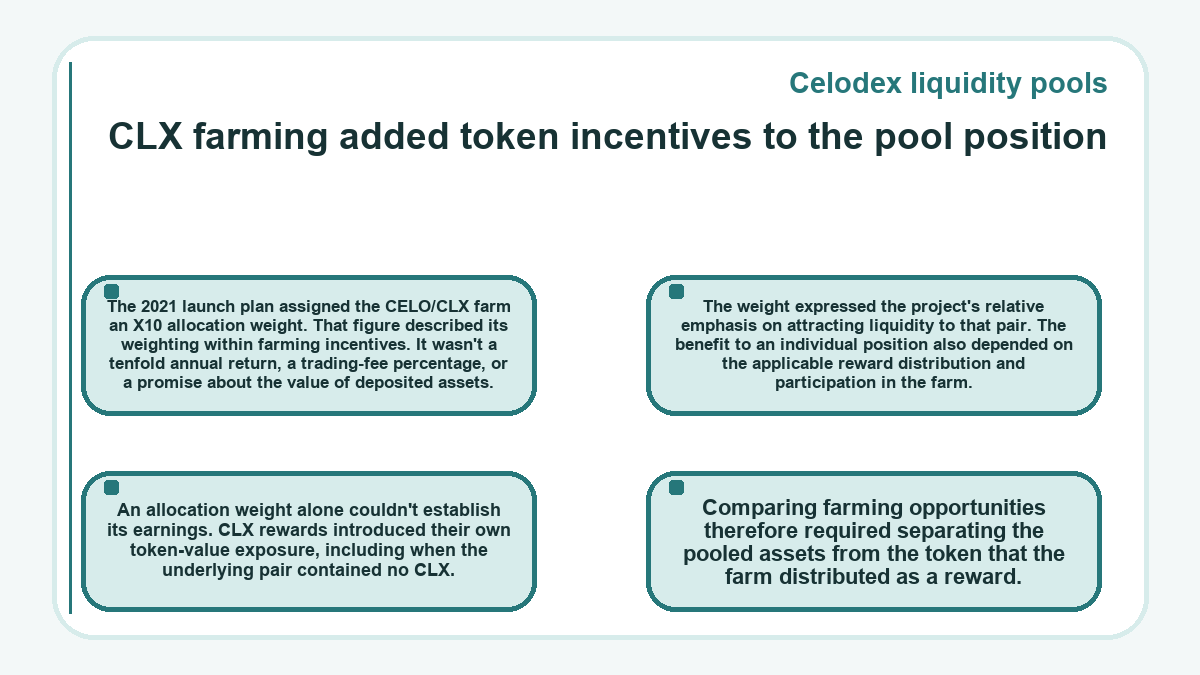
The benefit to an individual position also depended on the applicable reward distribution and participation in the farm. An allocation weight alone couldn't establish its earnings. CLX rewards introduced their own token-value exposure, including when the underlying pair contained no CLX. Comparing farming opportunities therefore required separating the pooled assets from the token that the farm distributed as a reward.
Could cUSD/cEUR preserve a fixed dollar balance?
The cUSD/cEUR pair didn't represent a fixed dollar balance because its tokens targeted different currencies. In the 2021 context, cUSD tracked the US dollar, while cEUR tracked the euro. Their relative values could move even when each tracked its intended currency. This made the pair a dollar-euro liquidity position. Calling both assets stablecoins didn't make their exchange rate constant or establish that fees would offset changes in the position's value.
CeloVAULT addressed automatic compounding
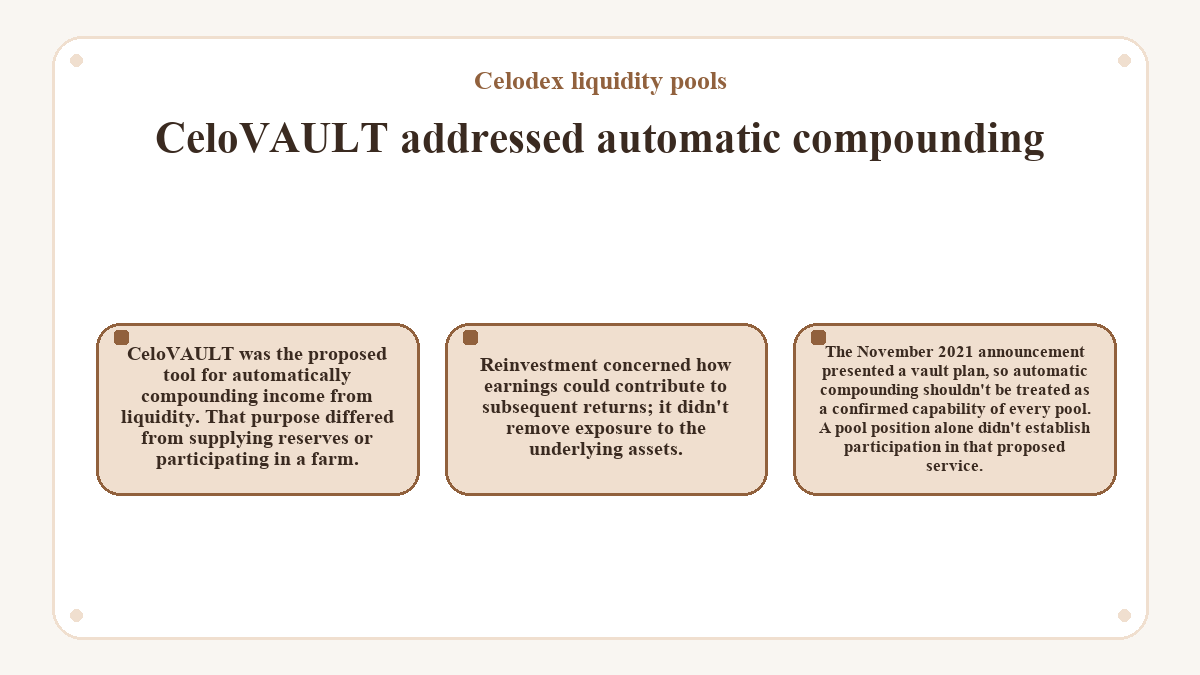
CeloVAULT was the proposed tool for automatically compounding income from liquidity. That purpose differed from supplying reserves or participating in a farm. Reinvestment concerned how earnings could contribute to subsequent returns; it didn't remove exposure to the underlying assets. The November 2021 announcement presented a vault plan, so automatic compounding shouldn't be treated as a confirmed capability of every pool. A pool position alone didn't establish participation in that proposed service.
Did a swap require a liquidity-provider position?
The 2021 AMM design supported token exchanges without requiring the trader to take on a continuing liquidity-provider position. A swap and a pool contribution served different purposes. The trader sought conversion between assets. The liquidity provider supplied reserves against which trades could occur, accepting the exposure associated with that contribution.
This distinction made a pool unsuitable when the entire task was a one-time exchange. Trading fees connected the two roles economically, but earning those fees involved providing capital to the pool.
Access conditions could change whether a pool fitted the task
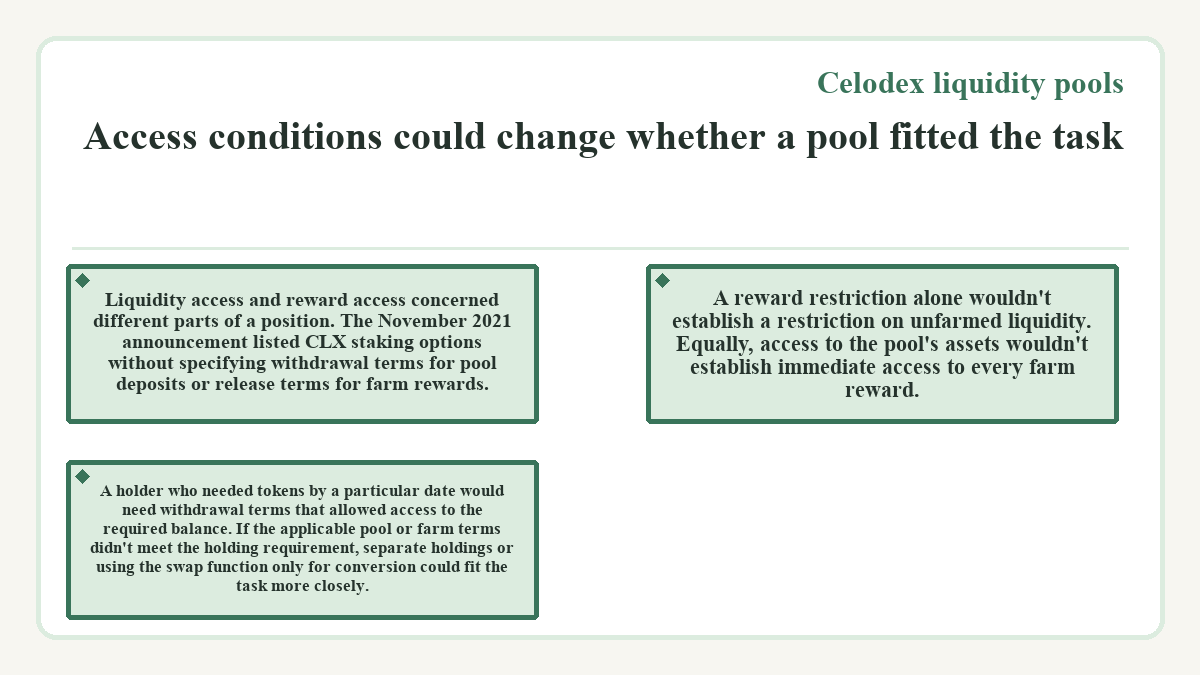
Liquidity access and reward access concerned different parts of a position. The November 2021 announcement listed CLX staking options without specifying withdrawal terms for pool deposits or release terms for farm rewards. A reward restriction alone wouldn't establish a restriction on unfarmed liquidity. Equally, access to the pool's assets wouldn't establish immediate access to every farm reward.
A holder who needed tokens by a particular date would need withdrawal terms that allowed access to the required balance. If the applicable pool or farm terms didn't meet the holding requirement, separate holdings or using the swap function only for conversion could fit the task more closely.
Questions people ask about Celodex liquidity pools
Did the WBTC/WETH pool accept Bitcoin directly from its native network?
The WBTC/WETH pool in the 2021 launch plan concerned tokens on Celo, so native Bitcoin wasn't its deposit asset. The tickers describe wrapped assets. Their token contracts and backing arrangements matter separately from the assets that they represent. A native-chain balance and the pool's supported Celo token instance aren't interchangeable liquidity inputs.
Which launch pools involved MOBI, SUSHI, and UBE?
The 2021 launch lineup included MOBI/CELO, SUSHI/CELO, and UBE/CELO. Each carried an X1 farming allocation weight in that plan. They shared a CELO component while exposing liquidity providers to different second tokens. Their common weight didn't make their trading activity, asset exposure, or economic outcomes identical.
Do the CLX staking locks set a pool deposit's withdrawal period?
The CLX staking menu didn't establish withdrawal terms for liquidity-pool deposits. The 2021 plan described CLX staking options with no lock or locks of seven, 30, and 180 days. Those durations concerned staking CLX. Applying them to a pool deposit would assume that the distinct arrangements shared the same access rules.
Does a pool's total liquidity reveal its providers' fee income?
Total liquidity measures assets supplied to a pool; it doesn't measure how much traders pay in fees. Fee income also depends on trading through that pool and the portion of fee revenue that a provider receives. A large reserve with little trading can generate less fee income than its size might suggest.
What does an annualized pool yield leave out of a use-case decision?
An annualized yield figure doesn't show whether a pool's paired assets match the intended exposure. Interpreting it also requires its measurement period and treatment of trading fees, token incentives, and reinvestment. A figure based on past activity can't specify what future trades or CLX rewards will deliver.
Last updated -