 Celodex
 CLX token connected farming incentives with planned rewards for longer staking locks
Celodex CLX token was the incentive token for Celodex on Celo, with a 2021 staking plan that favored longer lock periods. The announced menu included no lock, seven days, 30 days, and 180 days. Longer commitments carried higher reward-distribution multipliers, while a separate farming allocation supported liquidity provision. A multiplier alone didn't establish a cash return. Reward quantity, access to tokens, and token value each affected what a holder could ultimately receive.
The short version: The 2021 CLX staking plan assigned higher reward weights to longer locks, without setting a fixed cash return.
The announced lock periods changed staking reward weights
No-lock and seven-day commitments
The menu included a no-lock choice and a seven-day lock carrying a 2x distribution multiplier. It didn't attach a numerical multiplier to the no-lock choice.
Thirty-day and 180-day commitments
A 30-day lock carried 5x, and a 180-day lock carried 10x in the 2021 menu.
Did CLX's 10x staking multiplier promise ten times the money?
The 180-day option's 10x label described a reward-distribution multiplier, without promising a tenfold return on money committed.
An individual payout required rules that connected the stake to a reward budget. The announced menu didn't provide a complete payout formula or establish how much CLX every participant would receive.
Money value introduced another variable: the price of CLX when tokens could actually be used or sold. A larger token amount could have a smaller monetary value if the token price fell sufficiently.
Comparing cumulative payouts also required a common time basis. Seven-day and 180-day commitments covered different intervals, and their multiplier labels weren't annual percentage yields.
An access requirement could change the lock choice
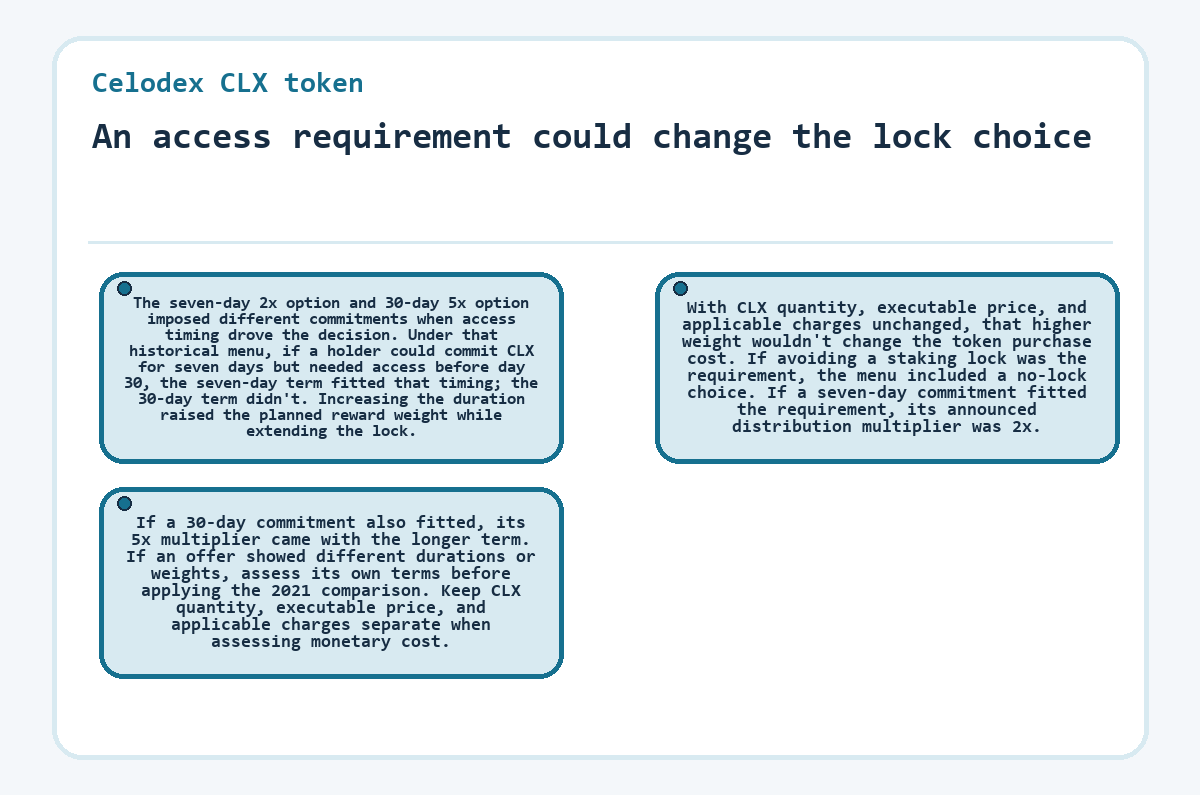
The seven-day 2x option and 30-day 5x option imposed different commitments when access timing drove the decision. Under that historical menu, if a holder could commit CLX for seven days but needed access before day 30, the seven-day term fitted that timing; the 30-day term didn't. Increasing the duration raised the planned reward weight while extending the lock. With CLX quantity, executable price, and applicable charges unchanged, that higher weight wouldn't change the token purchase cost.
- If avoiding a staking lock was the requirement, the menu included a no-lock choice.
- If a seven-day commitment fitted the requirement, its announced distribution multiplier was 2x.
- If a 30-day commitment also fitted, its 5x multiplier came with the longer term.
- If an offer showed different durations or weights, assess its own terms before applying the 2021 comparison.
- Keep CLX quantity, executable price, and applicable charges separate when assessing monetary cost.
Farming allocations and staking multipliers governed different commitments
The farming program attached allocation weights to liquidity pools, while the staking menu attached multipliers to CLX commitment periods.
A pool weight described a farming allocation
The launch plan assigned CELO/CLX a 10x farming weight and CLX/cEUR and CLX/cUSD 6x each. Those weights concerned the pools' incentive allocations.
A staking multiplier described a lock choice
The 180-day 10x choice concerned the staking menu. The matching 10x labels in the farming and staking plans didn't establish that someone could combine their multipliers.
The supply budget divided CLX among distinct allocations
The launch budget covered incentives, development, marketing, the treasury, a reserve for PLX holders, and initial liquidity. The November 2021 plan set CLX's maximum supply at 100,000,000 tokens.
Liquidity incentives accounted for 44,500,000 CLX, or 44.5% of the announced maximum. Vault incentives had a separate allocation of 20,000,000 CLX, or 20%. Together, those incentive categories accounted for 64.5% of the announced maximum supply.
Development and marketing each had 10,000,000 CLX, representing 10% apiece. The treasury allocation stood at 5,000,000 CLX, or 5%.
The main reserve for Polygon PLX holders accounted for 10,000,000 CLX, or 10%. Initial liquidity accounted for 500,000 CLX, or 0.5%. Each percentage used the announced maximum supply as its denominator.
Maximum supply left circulating supply unresolved
The planned maximum supply described a token-count ceiling; the allocation breakdown didn't measure CLX already circulating or available for sale. Circulation depended on actual issuance and distribution. A staking lock could separately restrict a holder's access to tokens already issued. The allocation list didn't supply a complete release schedule for every category, so it couldn't establish the number of immediately tradable tokens.
CeloVAULT linked planned performance fees to CLX and PLX support
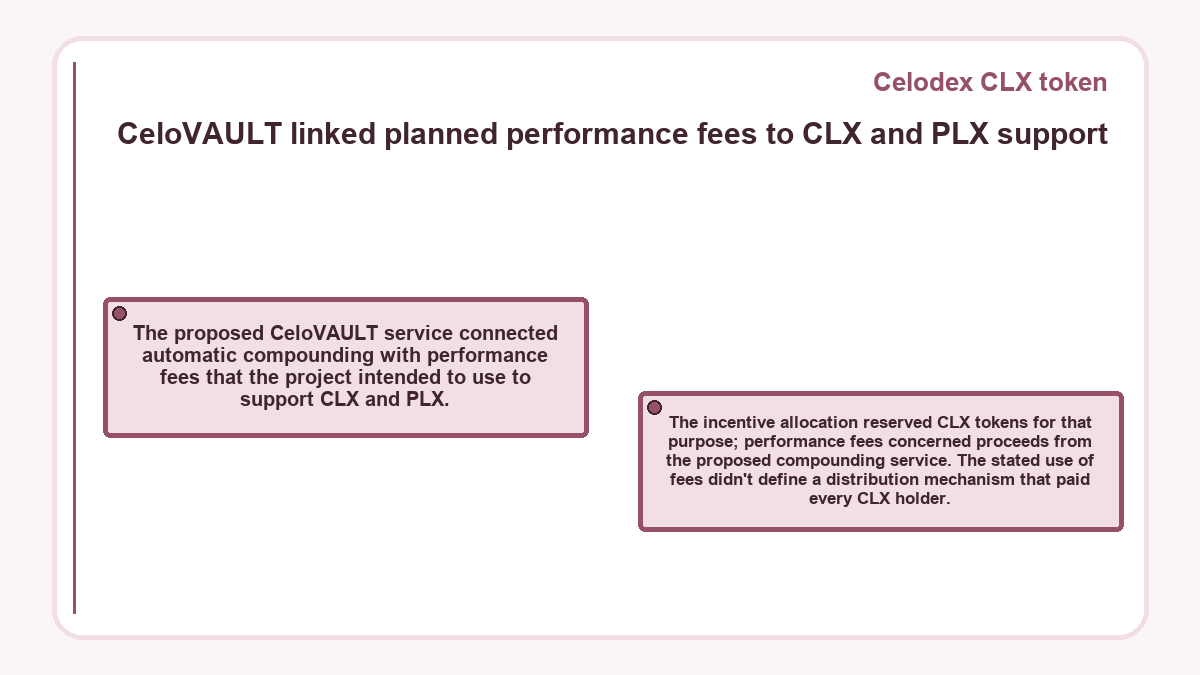
The proposed CeloVAULT service connected automatic compounding with performance fees that the project intended to use to support CLX and PLX. The incentive allocation reserved CLX tokens for that purpose; performance fees concerned proceeds from the proposed compounding service.
The stated use of fees didn't define a distribution mechanism that paid every CLX holder.
CLX purchase costs and locked-token value followed different inputs
The cost of buying CLX would depend on quantity and executable price, plus any applicable trading or network charges.
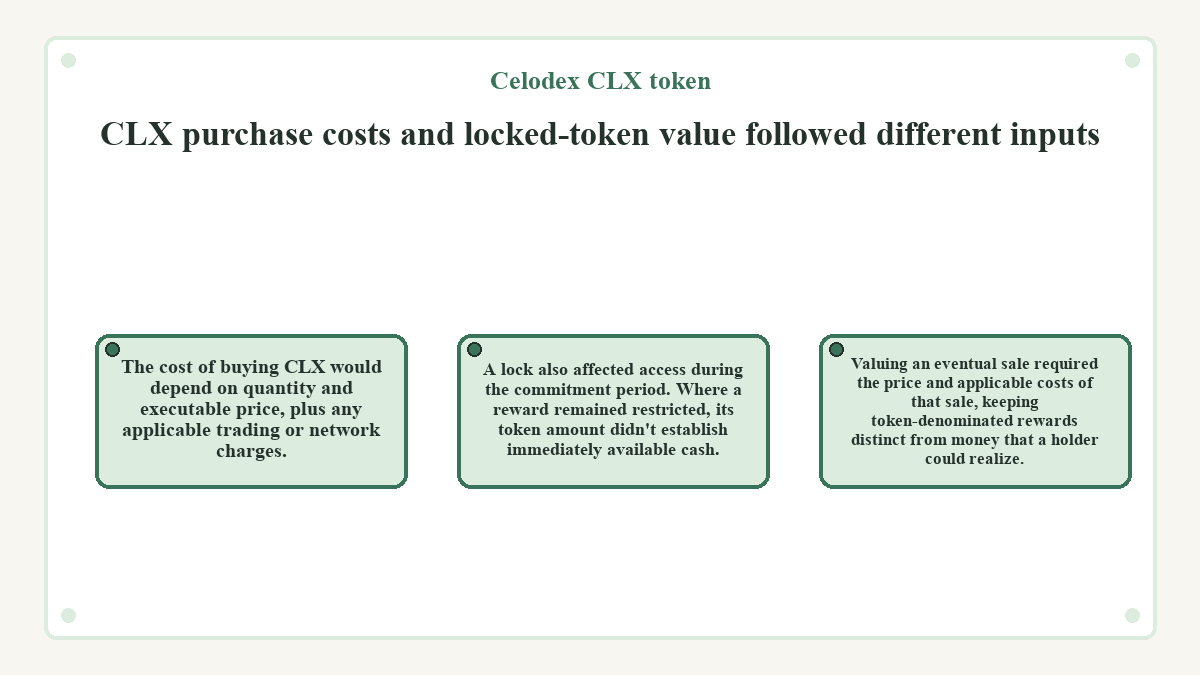
A lock also affected access during the commitment period. Where a reward remained restricted, its token amount didn't establish immediately available cash. Valuing an eventual sale required the price and applicable costs of that sale, keeping token-denominated rewards distinct from money that a holder could realize.
The 2021 menu didn't establish current staking access
The 2021 menu described launch-era staking intentions; it doesn't establish today's availability, distribution rates, or withdrawal terms for CLX. Present staking availability remains unconfirmed.
A lock duration also differed from an individual unlock date. Establishing that date required the particular position's start time and applicable terms. A historical lock duration alone couldn't identify how much of a particular stake's commitment remained.
Practical questions about Celodex CLX token
-
Which CLX contract did the 2021 launch plan identify on Celo?
- The November 6, 2021 launch plan identified 0xC7144Fa865c9f3a6836167A51531A2CC8b0ab5fD as Celodex's CLX token contract on Celo. Another asset sharing the CLX ticker wouldn't establish the same token identity.
-
Did choosing a no-lock CLX stake unlock earlier farming rewards?
- The 2021 plan's no-lock staking option didn't establish immediate access to previously earned farming rewards. The announcement didn't say whether farming rewards were restricted or whether choosing a staking option affected their release.
-
Could Polygon PLX holders claim a fixed CLX amount from the announced reserve?
- The 2021 reserve allocation didn't set a fixed CLX claim amount for individual PLX holders. It assigned 10,000,000 CLX to a main reserve for Polygon PLX holders, without setting out a conversion ratio or each holder's entitlement. That allocation described a token budget, with individual claim conditions left unspecified.
-
What performance-fee percentage did the 2021 CeloVAULT plan specify?
- The 2021 CeloVAULT proposal didn't specify a performance-fee percentage. It described an intended use for performance fees that would support CLX and PLX. Describing the use of those fees didn't establish their calculation base, a rate on the entire deposit, or a charge on all CLX balances.
Last updated -